Is Projection Function Continuous Unde Rbox Topology

Proof: Let W Y {\displaystyle W\subseteq Y} be an arbitrary open set; we are to show that f 1 ( W ) {\displaystyle f^{-1}(W)} is open. Now a basis of the topology on Y {\displaystyle Y} is given by

B := { B 1 B n | n N , B 1 , , B n B } {\displaystyle {\mathcal {B}}':=\{B_{1}\cap \cdots \cap B_{n}|n\in \mathbb {N} ,B_{1},\ldots ,B_{n}\in {\mathcal {B}}\}} .

Since intersections commute with preimages, f 1 ( V ) {\displaystyle f^{-1}(V)} is open for V B {\displaystyle V\in {\mathcal {B}}'} . But all open sets of Y {\displaystyle Y} are unions of elements of B {\displaystyle {\mathcal {B}}'} , and preimages commute with unions, so that f {\displaystyle f} is continuous. {\displaystyle \Box }

Proposition (category of topological spaces):

The class of all topological spaces, together with the continuous functions between them as morphisms, forms a category.

Proof: Indeed, the composition of continuous functions is again continuous, and further, the identity (which is unique, by composing any other identity with the above identity) is well-defined. {\displaystyle \Box }

Proof: First suppose that all the functions f α g {\displaystyle f_{\alpha }\circ g} are continuous, and let U X {\displaystyle U\subseteq X} be open, so that we may write

U = β B C β {\displaystyle U=\bigcup _{\beta \in B}C_{\beta }} , C β = f α β , 1 1 ( U α β , 1 ) f α β , n β 1 ( U α β , n β ) {\displaystyle C_{\beta }=f_{\alpha _{\beta ,1}}^{-1}(U_{\alpha _{\beta ,1}})\cap \cdots \cap f_{\alpha _{\beta ,n_{\beta }}}^{-1}(U_{\alpha _{\beta ,n_{\beta }}})}

since we saw that the sets C β {\displaystyle C_{\beta }} thus defined form a basis of the initial topology. Then g 1 ( U ) {\displaystyle g^{-1}(U)} is open in Z {\displaystyle Z} since taking preimages commutes with taking unions and intersections. Further, observe that all functions f α {\displaystyle f_{\alpha }} are continuous, so that the function f α g {\displaystyle f_{\alpha }\circ g} are continuous when g {\displaystyle g} is. {\displaystyle \Box }

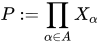
Proof: Let another cone over the diagram be given that contains as points the X α {\displaystyle X_{\alpha }} and no morphism, and suppose that the object of that cone is called a {\displaystyle a} and the arrows of that cone are called ϕ α : a X α {\displaystyle \phi _{\alpha }:a\to X_{\alpha }} , so that a {\displaystyle a} is a topological space and the ϕ α {\displaystyle \phi _{\alpha }} are continuous functions. To ease notation, set P := α A X α {\displaystyle P:=\prod _{\alpha \in A}X_{\alpha }} , and define

ψ : a P , ψ ( x ) := ( ϕ α ( x ) ) α A {\displaystyle \psi :a\to P,\psi (x):=(\phi _{\alpha }(x))_{\alpha \in A}} .

Note that ψ {\displaystyle \psi } is the unique map that has the property that π α ψ ( x ) = ϕ α ( x ) {\displaystyle \pi _{\alpha }\circ \psi (x)=\phi _{\alpha }(x)} , since the projection is simply given by taking the α {\displaystyle \alpha } -th component. Furthermore, note that ψ {\displaystyle \psi } is continuous, since the ϕ α = π α ψ {\displaystyle \phi _{\alpha }=\pi _{\alpha }\circ \psi } are continuous, P {\displaystyle P} has the initial topology of the π α {\displaystyle \pi _{\alpha }} , and we conclude by the characterisation of continuity of functions to a space with initial topology. Thus, P {\displaystyle P} is a product. {\displaystyle \Box }

Continuity is a local property, in that it may be characterized by a property that a function might have at every point.

Proposition (continuity is equivalent to continuity at each point):

Let X , Y {\displaystyle X,Y} be topological spaces and f : X Y {\displaystyle f:X\to Y} be a function. f {\displaystyle f} is continuous if and only if it is continuous at all x X {\displaystyle x\in X} .

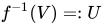
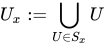
Proof: Suppose first that f {\displaystyle f} is continuous, and let x X {\displaystyle x\in X} . Let V Y {\displaystyle V\subseteq Y} be an open neighbourhood of f ( x ) {\displaystyle f(x)} , then by continuity f 1 ( V ) =: U {\displaystyle f^{-1}(V)=:U} is an open neighbourhood of x {\displaystyle x} and by definition of the preimage f ( U ) V {\displaystyle f(U)\subseteq V} . Suppose now that f {\displaystyle f} is continuous at each point x X {\displaystyle x\in X} , and let V Y {\displaystyle V\subseteq Y} be any open set. We are to show that f 1 ( V ) {\displaystyle f^{-1}(V)} is open. Indeed, let x f 1 ( V ) {\displaystyle x\in f^{-1}(V)} be arbitrary, so that f ( x ) V {\displaystyle f(x)\in V} . By continuity at x {\displaystyle x} , we find that the sets S x {\displaystyle S_{x}} of neighbourhoods U {\displaystyle U} of x {\displaystyle x} such that f ( U ) V {\displaystyle f(U)\subseteq V} is nonempty. (Note: We are inserting here an additional step of choosing a canonical neighbourhood for each x {\displaystyle x} in order to avoid the axiom of choice.) Define

U x := U S x U {\displaystyle U_{x}:=\bigcup _{U\in S_{x}}U} ,

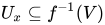
which is an open neighbourhood of x {\displaystyle x} and has the property that f ( U x ) V {\displaystyle f(U_{x})\subseteq V} , that is, U x f 1 ( V ) {\displaystyle U_{x}\subseteq f^{-1}(V)} . Then we obtain

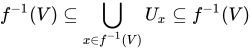
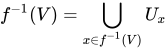
f 1 ( V ) x f 1 ( V ) U x f 1 ( V ) {\displaystyle f^{-1}(V)\subseteq \bigcup _{x\in f^{-1}(V)}U_{x}\subseteq f^{-1}(V)} , ie. f 1 ( V ) = x f 1 ( V ) U x {\displaystyle f^{-1}(V)=\bigcup _{x\in f^{-1}(V)}U_{x}} ,

which is open as the union of open sets. {\displaystyle \Box }

Proposition (characterisation of continuity by closed sets):

Let f : X Y {\displaystyle f:X\to Y} be a function between topological spaces.

f {\displaystyle f} is continuous if and only if f 1 ( A ) {\displaystyle f^{-1}(A)} is closed in X {\displaystyle X} for all closed subsets A Y {\displaystyle A\subseteq Y} .

Proof: f {\displaystyle f} is continuous if and only if for all open subsets V Y {\displaystyle V\subseteq Y} , the set f 1 ( V ) {\displaystyle f^{-1}(V)} is open in X {\displaystyle X} . The open subsets of Y {\displaystyle Y} are in bijective correspondence to the closed subsets of Y {\displaystyle Y} via the map V Y V {\displaystyle V\mapsto Y\setminus V} , and the same holds for X {\displaystyle X} . Now note that f 1 ( Y V ) = f 1 ( Y ) f 1 ( V ) = X f 1 ( V ) {\displaystyle f^{-1}(Y\setminus V)=f^{-1}(Y)\setminus f^{-1}(V)=X\setminus f^{-1}(V)} , so that the latter is closed precisely when the former is. In particular, the latter is always closed whenever f 1 ( V ) {\displaystyle f^{-1}(V)} is always open, and if the latter is always closed, then f 1 ( V ) {\displaystyle f^{-1}(V)} is always open. {\displaystyle \Box }

Proof: We show that f 1 ( C ) {\displaystyle f^{-1}(C)} is closed for all closed subsets C Y {\displaystyle C\subseteq Y} , thereby proving continuity by the characterisation of continuous functions by the preimages of closed sets. Indeed, let C Y {\displaystyle C\subseteq Y} be closed. Note that

f 1 ( C ) = f | A 1 ( C ) f | B 1 ( C ) {\displaystyle f^{-1}(C)=f|_{A}^{-1}(C)\cup f|_{B}^{-1}(C)} ,

that is, f 1 ( C ) {\displaystyle f^{-1}(C)} is the union of two closed sets and thus itself closed. {\displaystyle \Box }

Proof: Let V Y {\displaystyle V\subseteq Y} be open. Then f 1 ( V ) {\displaystyle f^{-1}(V)} is open in X {\displaystyle X} , so that f 1 ( V ) S = f | S 1 ( V ) {\displaystyle f^{-1}(V)\cap S=f|_{S}^{-1}(V)} is open in the subspace topology on S {\displaystyle S} . {\displaystyle \Box }

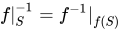
Proof: f | S {\displaystyle f|_{S}} is continuous since the restriction of a continuous function is continuous. Further, f | S 1 = f 1 | f ( S ) {\displaystyle f|_{S}^{-1}=f^{-1}|_{f(S)}} , which is likewise continuous as the restriction of a continuous map. Therefore, f | S {\displaystyle f|_{S}} is a homeomorphism. {\displaystyle \Box }

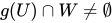
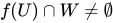
Proof: Set y := f ( x 0 ) {\displaystyle y:=f(x_{0})} . By definition of equicontinuity, whenever V {\displaystyle V} is a neighbourhood of y {\displaystyle y} , we find neighbourhoods U {\displaystyle U} of x 0 {\displaystyle x_{0}} and W {\displaystyle W} of y {\displaystyle y} so that whenever g ( U ) W {\displaystyle g(U)\cap W\neq \emptyset } for g H {\displaystyle g\in H} arbitrary, then g ( U ) V {\displaystyle g(U)\subseteq V} . But since f ( x 0 ) = y {\displaystyle f(x_{0})=y} , we have f ( U ) W {\displaystyle f(U)\cap W\neq \emptyset } , so that f ( U ) V {\displaystyle f(U)\subseteq V} and f {\displaystyle f} is continuous at x 0 {\displaystyle x_{0}} . {\displaystyle \Box }

When Y {\displaystyle Y} is a uniform space, the definition of equicontinuity simplifies, and furthermore in this situation equicontinuous subsets are related to compact subsets of C ( X , Y ) {\displaystyle {\mathcal {C}}(X,Y)} . This we will see in the chapter on uniform structures.

In other words, a function f : X Y {\displaystyle f:X\to Y} is a local homeomorphism if and only if for all x 0 X {\displaystyle x_{0}\in X} , there exists an open neighbourhood U {\displaystyle U} of x 0 {\displaystyle x_{0}} and an open neighbourhood V {\displaystyle V} of f ( x 0 ) {\displaystyle f(x_{0})} so that f | U {\displaystyle f|_{U}} is a homeomorphism from U {\displaystyle U} to V {\displaystyle V} .

Proposition (local homeomorphisms are open):

Let f : X Y {\displaystyle f:X\to Y} be a local homeomorphism. Then f {\displaystyle f} is an open map.

Proof: Indeed, let U X {\displaystyle U\subseteq X} be open, and let y f ( X ) {\displaystyle y\in f(X)} be arbitrary. Pick x f 1 ( y ) {\displaystyle x\in f^{-1}(y)} arbitrary. Then since f {\displaystyle f} is a local homeomorphism, we find U X {\displaystyle U\subseteq X} open with x U {\displaystyle x\in U} such that f ( U ) {\displaystyle f(U)} is open. Further, y f ( U ) f ( X ) {\displaystyle y\in f(U)\subseteq f(X)} . Since f ( X ) {\displaystyle \in f(X)} was arbitrary, f ( X ) {\displaystyle f(X)} is open. {\displaystyle \Box }

Definition (embedding):

An embedding is a continuous function f : X Y {\displaystyle f:X\to Y} between topological spaces so that f {\displaystyle f} is a homeomorphism between X {\displaystyle X} and f ( X ) {\displaystyle f(X)} .

Proof: f : X Y {\displaystyle f:X\to Y} is continuous iff for all open V Y {\displaystyle V\subseteq Y} , the set f 1 ( V ) {\displaystyle f^{-1}(V)} is open in X {\displaystyle X} . This in turn is equivalent to f 1 ( V ) {\displaystyle f^{-1}(V)} being open in all topologies τ α {\displaystyle \tau _{\alpha }} ( α A {\displaystyle \alpha \in A} ) for arbitrary open V Y {\displaystyle V\subseteq Y} . And this condition translates that f {\displaystyle f} is continuous with respect to all topologies τ α {\displaystyle \tau _{\alpha }} ( α A {\displaystyle \alpha \in A} ) on X {\displaystyle X} . {\displaystyle \Box }

Proof: f {\displaystyle f} is continuous iff for all open V {\displaystyle V} , the set f 1 ( V ) {\displaystyle f^{-1}(V)} is open. If that is the case, then all the sets f 1 ( V ) {\displaystyle f^{-1}(V)} are open, where V τ α {\displaystyle V\in \tau _{\alpha }} ( α A {\displaystyle \alpha \in A} arbitrary), so that f {\displaystyle f} is continuous with respect to all topologies τ α {\displaystyle \tau _{\alpha }} . Suppose now that f {\displaystyle f} is continuous with respect to all these topologies. Note that since the least upper bound topology on Y {\displaystyle Y} with respect to the τ α {\displaystyle \tau _{\alpha }} is the topology generated by α A τ α {\displaystyle \bigcup _{\alpha \in A}\tau _{\alpha }} , the latter forms a subbasis of the least upper bound topology. Hence, we may apply the characterisation of continuity via subbasis. {\displaystyle \Box }

mclendonhilis1956.blogspot.com

Source: https://en.wikibooks.org/wiki/General_Topology/Continuity

0 Response to "Is Projection Function Continuous Unde Rbox Topology"

Post a Comment

Iklan Atas Artikel

Iklan Tengah Artikel 1

Iklan Tengah Artikel 2

Iklan Bawah Artikel